Annual Reports
Sportradar Group AG's annual reports contain management's most considered account of the business. These are the sections, passages and visual pages worth opening in the originals preserved in Sources.
Sportradar Group AG — FY2025 Annual Report (Form 20-F) — FY2025
€1.29bn revenue, the IMG ARENA acquisition, prediction markets as a new competitive vector, and a second year of failed internal control. · Open the full document →
We depend on the success of our strategic relationships with our sports league partners, and our inability to maintain, extend, or establish new relationships may cause loss of competitive advantage, unanticipated costs, or require us to modify, limit, or discontinue certain offerings, which could materially affect our business, financial condition, and results of operations. — p. 13 · Read the full section →
The supply side of the business: rights it does not own, renewed on someone else's terms, now bid for by prediction markets too.
Our market is competitive and we may lose clients and relationships to both existing and future competitors. Potential changes in competitive landscape, including new market entrants or disintermediation by participants in the industry, could harm our business. In addition, the introduction of sports-event contracts trading offered by prediction markets creates uncertainty affecting our business. — p. 14 · Read the full section →
New this year: CFTC-regulated event contracts sit outside the state betting regime Sportradar's clients are licensed under.
Prediction markets framed as opportunity and threat at once, across competitive, regulatory and contractual lines.
In the United States, prediction markets, which are CFTC-regulated platforms that allow participants to trade event contracts based on the outcome of future events, are emerging as a potential innovation in sports engagement and data monetization. While these prediction markets has created and could create more opportunities for us to leverage our data and other products and services, they also present significant uncertainties. These uncertainties include, among others, competitive risks, regulatory risks and contractual risks.
p. 14 · Read in context →
The dual class structure of our ordinary shares has the effect of concentrating voting power with our Founder, which will limit a shareholder’s ability to influence the outcome of important transactions, including a change in control. — p. 42 · Read the full section →
Class A holders own economics, not control: the founder holds 78.5% of voting power through low-par Class B shares.
Founder voting power at December 31, 2025, and what it forecloses.
As of December 31, 2025, our Founder, Carsten Koerl, holds all of the issued and outstanding shares of our Class B ordinary shares, which, together with his outstanding Class A ordinary shares, constitutes 78.5% of the total voting power of our outstanding share capital. Accordingly, our Founder is able to significantly influence matters submitted to our shareholders for approval, including the election of directors, amendments of our organizational documents and any merger, consolidation, sale of all or substantially all of our assets or other major corporate transactions. […] This concentrated control may have the effect of delaying, preventing or deterring a change in control of our company, could deprive our shareholders of an opportunity to receive a premium for their share capital as part of a sale of our company and might ultimately affect the market price of our Class A ordinary shares.
p. 42 · Read in context →
Item 4.B Business Overview — p. 48 · Read the full section →
Management's own definition of the business, and the rights portfolio it treats as the moat.
What Sportradar sells and to whom, in management's words.
Sportradar is a leading technology platform enabling next generation engagement in sports and the number one provider of B2B solutions to the global sports betting industry based on revenue. We provide mission-critical products, data and content to sports leagues and federations, betting operators and media companies. […] We offer one of the most robust platforms with seamless integrations between leagues, betting operators and media companies. This enables us to be a trusted partner and leader in navigating the complexities of the highly regulated betting industry. Our software solutions cover a broad range of the sports industry needs, from data collection and processing to visualization, risk management, and platform services.
p. 48 · Read in context →
The named Tier 1 exclusive rights behind the moat claim.
We also leverage our highly diversified sport rights partnerships as a key competitive advantage for our product offerings and client solutions. We have strategically cultivated sport partnerships that include a range of exclusive rights with many Tier 1 properties, including, but not limited to, the National Basketball Association (“NBA”), Major League Baseball (“MLB”), the National Hockey League (“NHL”), the PGA Tour, Major League Soccer (“MLS”), Association of Tennis Professionals (“ATP”), Fédération Internationale des Associations de Football (“FIFA”), the South American Football Confederation (“CONMEBOL”), Union of European Football Associations (“UEFA”), the Asian Football Confederation (“AFC”), and the Deutsche Fußball Liga (“DFL”).
p. 49 · Read in context →
Key Financial and Operational Performance Indicators — p. 67 · Read the full section →
The scoreboard management runs on, plus its argument for why sport rights amortization stays inside Adjusted EBITDA.
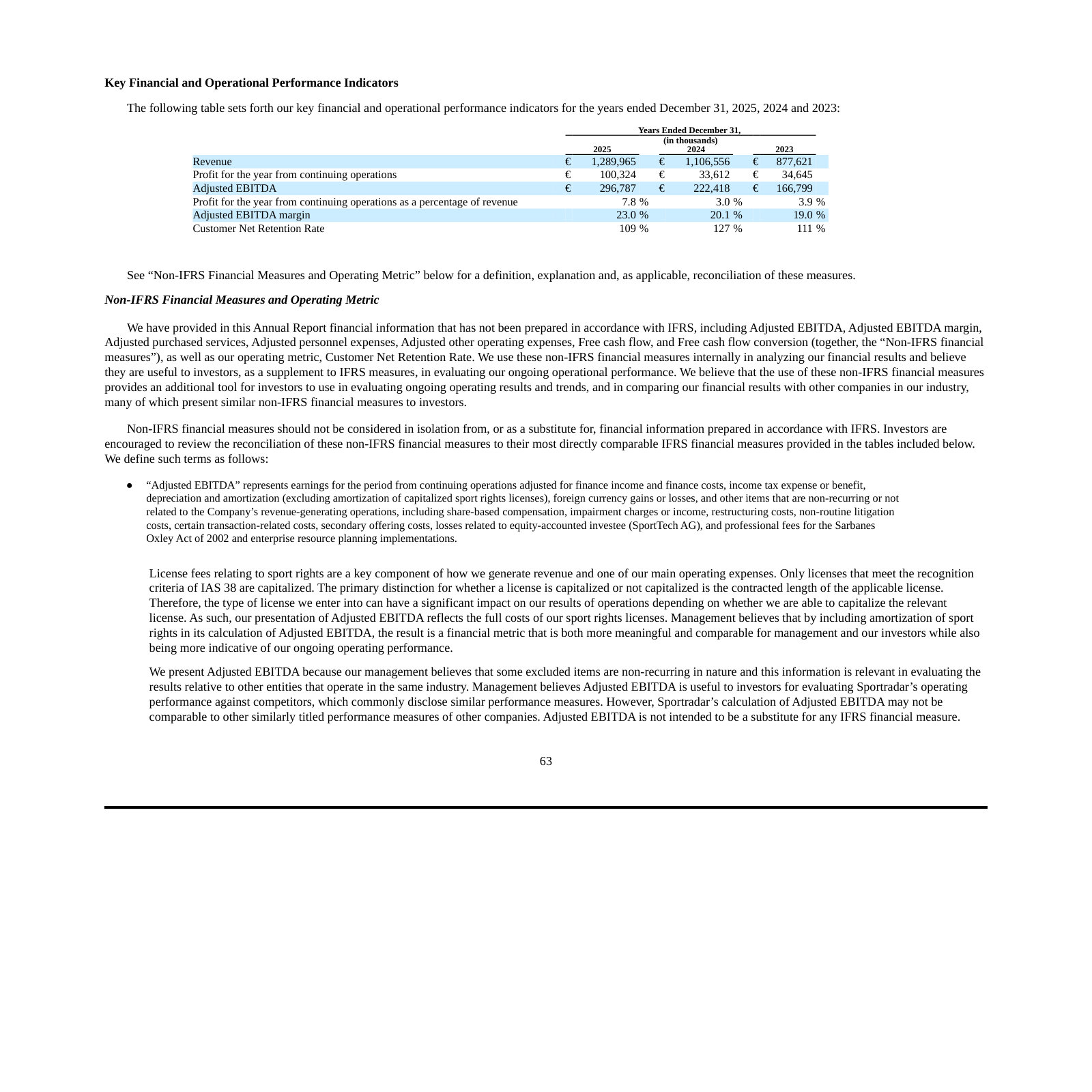
Why the capitalize-or-expense choice on licenses drives reported results.
License fees relating to sport rights are a key component of how we generate revenue and one of our main operating expenses. Only licenses that meet the recognition criteria of IAS 38 are capitalized. The primary distinction for whether a license is capitalized or not capitalized is the contracted length of the applicable license. Therefore, the type of license we enter into can have a significant impact on our results of operations depending on whether we are able to capitalize the relevant license. As such, our presentation of Adjusted EBITDA reflects the full costs of our sport rights licenses.
p. 67 · Read in context →
Components of our Results of Operations — Revenue — p. 71 · Read the full section →
How the money is actually made: five revenue lines, and contracts split between fixed minimums and GGR revenue share.
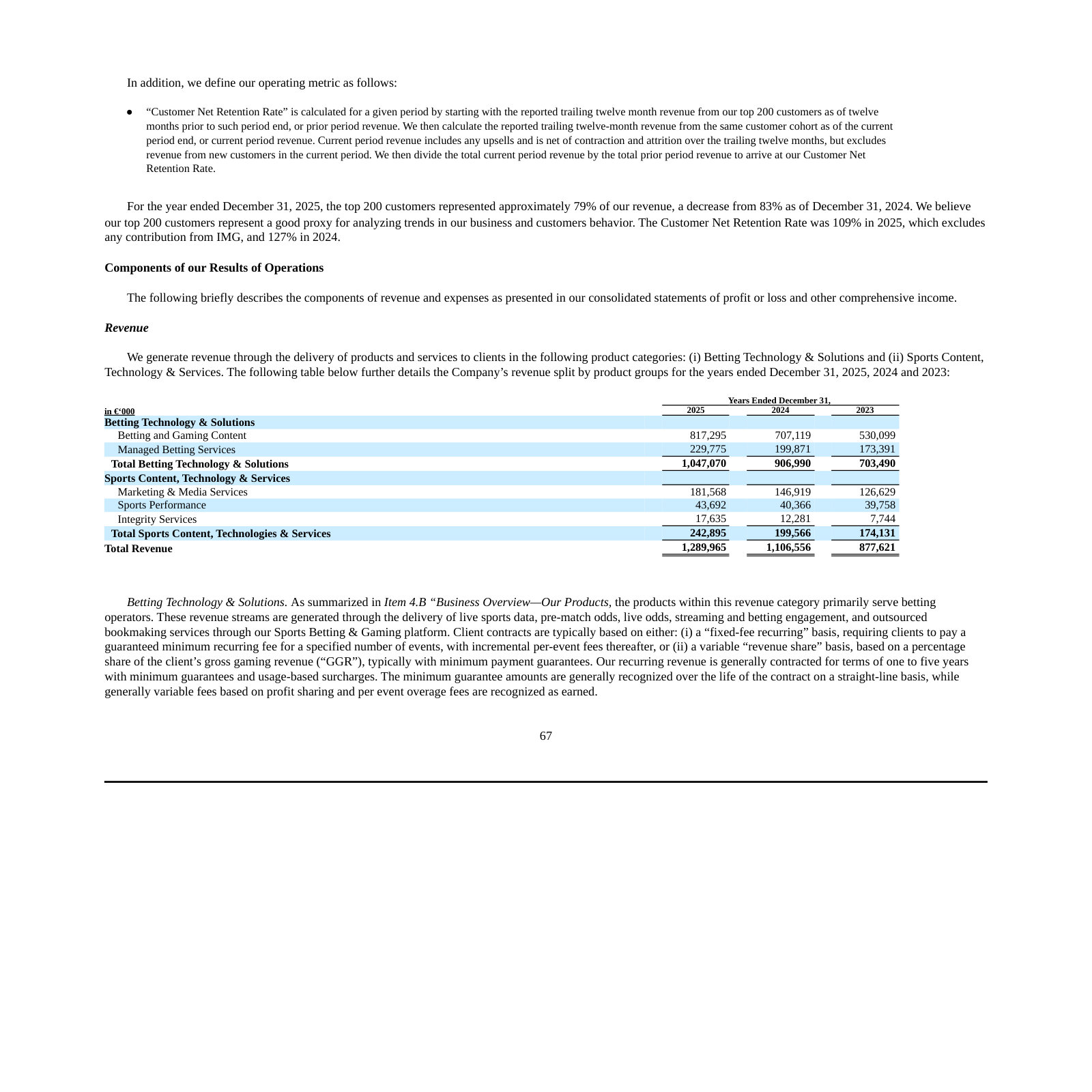
The two contract forms behind Betting Technology & Solutions revenue.
Client contracts are typically based on either: (i) a “fixed-fee recurring” basis, requiring clients to pay a guaranteed minimum recurring fee for a specified number of events, with incremental per-event fees thereafter, or (ii) a variable “revenue share” basis, based on a percentage share of the client’s gross gaming revenue (“GGR”), typically with minimum payment guarantees. Our recurring revenue is generally contracted for terms of one to five years with minimum guarantees and usage-based surcharges. The minimum guarantee amounts are generally recognized over the life of the contract on a straight-line basis, while generally variable fees based on profit sharing and per event overage fees are recognized as earned.
p. 71 · Read in context →
Comparison of Results for the Fiscal Years Ended December 31, 2025 and 2024 — p. 73 · Read the full section →
Where profit tripled: a €117m swing in FX on dollar sport-rights payables sits alongside 17% revenue growth.
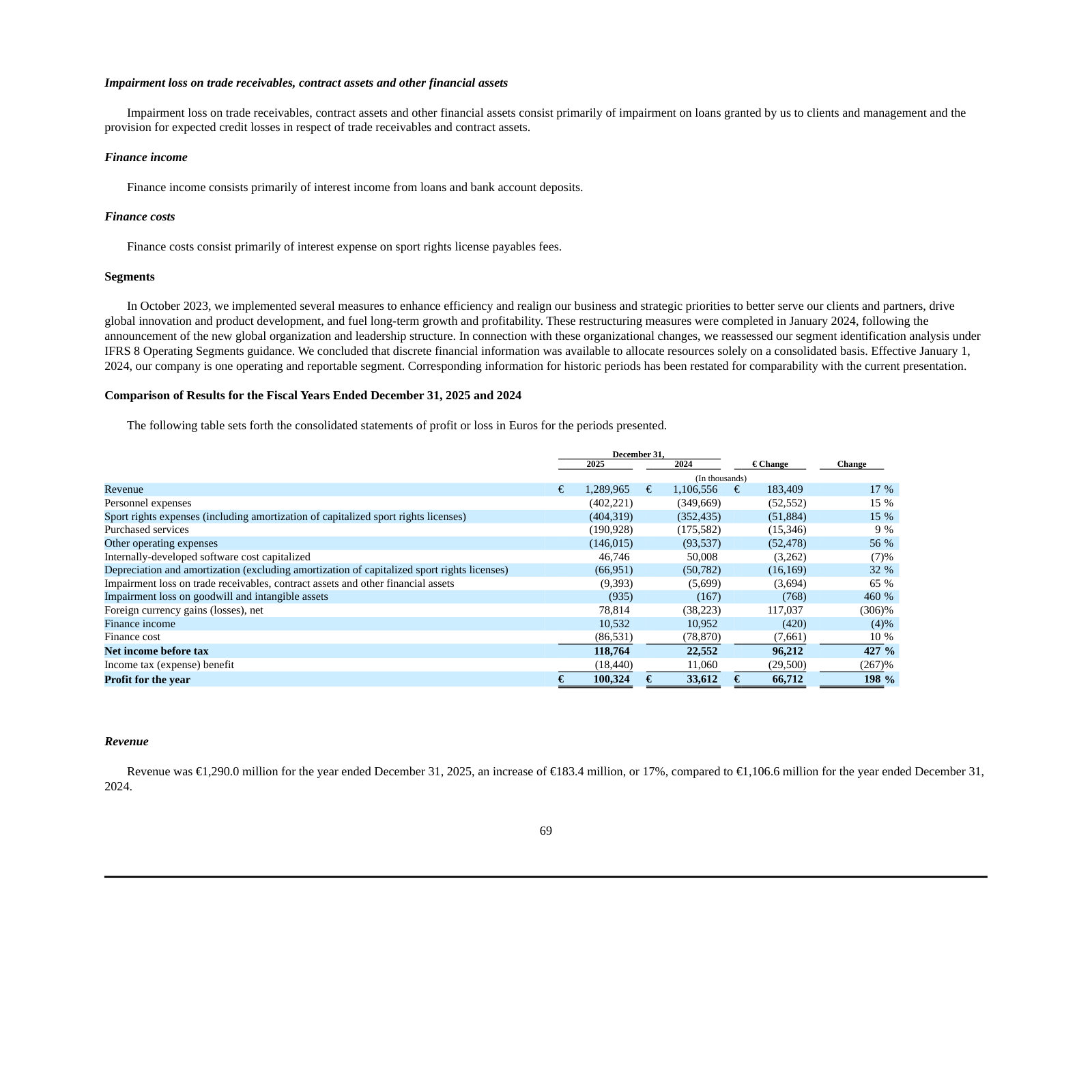
Management's attribution of the revenue increase by product group.
Betting Technology & Solutions revenues of €1,047.1 million were up 15% year-over-year primarily driven by a 16% increase in Betting and Gaming Content due to customer uptake of our content and products, contributions related to the acquisition of IMG ARENA, as well as from U.S. market growth, partially offset by the impact of foreign currency movements. Managed Betting Services revenues of €229.8 million were up 15% driven by strong growth in Managed Trading Services due to higher turnover and new clients. […] Sports Content, Technology & Services revenues of €242.9 million increased 22% year-over-year primarily driven by a 24% increase in Marketing & Media Services due to increased spending from technology and media customers and contributions related to our expanded affiliate marketing capabilities.
p. 74 · Read in context →
Item 15. Controls and Procedures — p. 107 · Read the full section →
A second straight year of ineffective internal control, and an adverse ICFR opinion from KPMG alongside a clean audit opinion.
Note 2.3 Use of judgments, estimates and assumptions — a) Newly acquired or modified sport rights licenses — p. 131 · Read the full section →
Whether a league deal becomes a €1.5bn intangible or an expense turns on IAS 38 judgment; KPMG calls it a critical audit matter.
Sportradar Group AG — FY2023 Annual Report (Form 20-F) — FY2023
Included for one section only: the last segment disclosure before the January 2024 collapse to a single reportable segment. · Open the full document →
Note 5. Segmental information — p. 163 · Read the full section →
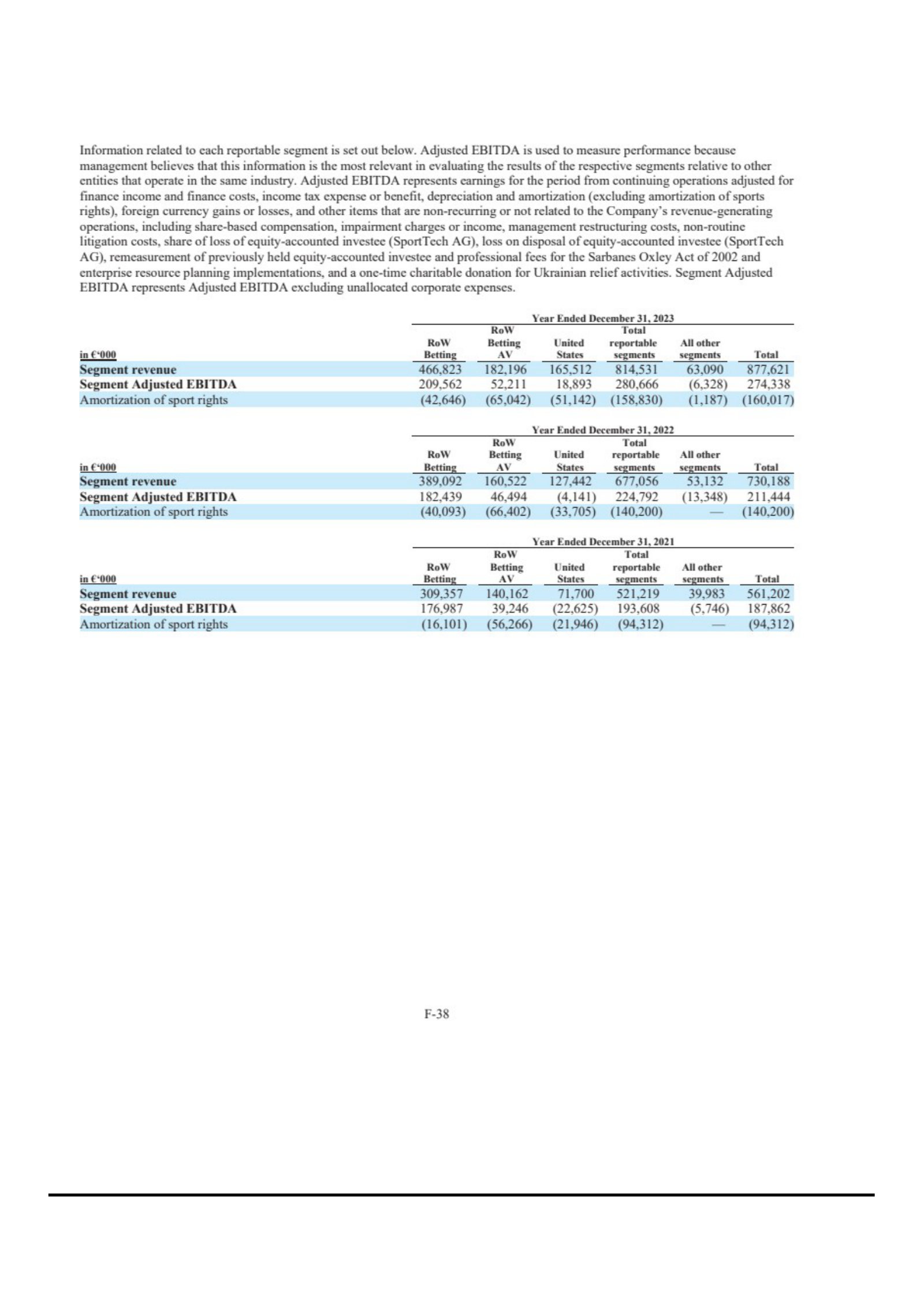
The last edition to report by segment: from January 1, 2024 Sportradar reports as one segment, so this split is never repeated.
The three reportable segments as defined before the 2024 consolidation.
During the years ended December 31, 2023, 2022 and 2021, the Company has the following divisions which are its reportable segments. These divisions offer different services and are managed separately by region
p. 163 · Read in context →
More annual reports
Sportradar Group AG — FY2024 Annual Report (Form 20-F) — FY2024 · 183 pages · Where the material weakness was first reported, and the first year presented on a single-segment basis. · Open →
Sportradar Group AG — FY2022 Annual Report (Form 20-F) — FY2022 · 205 pages · €730m revenue year on the old three-segment basis, before the 2023 restructuring. · Open →
Sportradar Group AG — FY2021 Annual Report (Form 20-F) — FY2021 · 213 pages · First annual report after the September 2021 Nasdaq listing; the baseline description of the platform. · Open →